
Biological age
Your epigenetic age comes with a margin of error nobody prints
A 2026 reliability study found that DNA methylation clocks are highly reproducible in the lab and considerably less stable in the person. That distinction matters enormously.

Biological age tests report a single number, usually to one decimal place. The precision of that presentation is not supported by the underlying measurement, and a 2026 study in Aging Cell put numbers on exactly how far apart those two things have drifted.
The short version
- The study evaluated 18 DNA methylation ageing biomarkers for both technical and biological reliability using the TranslAGE platform.
- Technical reproducibility, meaning agreement between laboratory replicates of the same sample, was high.
- Biological reliability, meaning agreement across repeated samples from the same person over short intervals, was only low to moderate for most clocks.
- Crucially, technical reproducibility did not predict biological reliability. A clock can be consistent in the lab and unstable in the body.
Two kinds of reliability
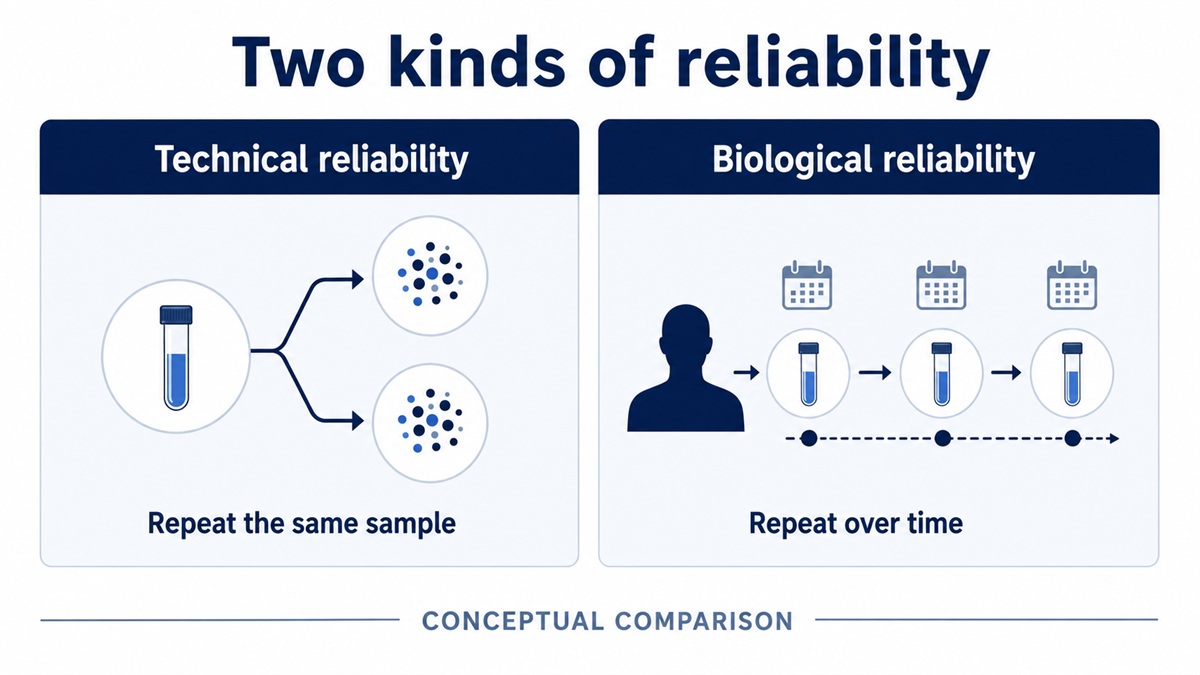
If you split one blood sample in two and run both, a good assay returns nearly identical answers. That is technical reliability, and epigenetic clocks do well on it. It is also the number most commercial providers cite when asked about accuracy.
Biological reliability asks something harder. If the same person gives samples on Monday and Thursday, having eaten differently, slept differently, and been more or less stressed, how close are the two results? The 2026 analysis found substantial fluctuation, with most clocks landing at moderate reliability at best, and stability falling further once immune cell composition was accounted for.
The finding the field found most uncomfortable is that these two properties are not linked. You cannot infer a clock's stability in a living person from how cleanly it replicates in a machine.
Why this changes what a result means
The consequence runs straight into how these tests are sold. If your reading moves by two years after six months of an intervention, and the measurement itself fluctuates by a similar magnitude in response to meals, stress, and environmental exposure, then the change carries very little information.
The same paper showed this is not hypothetical. Clocks with better reliability produced more stable associations with cognitive outcomes and more consistent responses to interventions. Less reliable clocks produced variable and sometimes misleading results. Instability does not merely add noise; it can generate spurious findings.
A result reported as 41.3 years carries a standard error commonly estimated at three to five years. The decimal point is the least defensible character on the report.
Toracix Health Report
What the researchers actually recommend
Nobody in this literature is arguing that epigenetic clocks are worthless. They are among the more promising ageing biomarkers and they correlate meaningfully with mortality and disease risk at population scale.
The argument is about the unit of analysis. These measures perform respectably when comparing groups of thousands. They perform poorly when asked to tell one person whether their supplement regimen is working. A commentary in eBioMedicine in 2026 made the same point about the gap between commercial wellness use and clinical readiness.
If you have already taken one
Treat the number as a very wide range rather than a point. If it came back older than your chronological age, the actionable interpretation is not that you need a specific product. It is that the behaviours consistently associated with faster measured ageing, smoking, poorly controlled glucose and blood pressure, and high BMI, are the same ones your clinician would already have raised.
And if you intend to retest, retest under matched conditions: same lab, same clock, same time of day, similar recent diet and sleep. That will not fix the reliability problem but it will stop you from adding to it.
How to read a clock result
A point estimate from a statistical model, not a measurement of a physical quantity. Reported precision reflects the model's output format, not measurement resolution.
Standard error is commonly estimated in the range of three to five years for epigenetic clocks. Almost no consumer report displays it.
A difference between two tests only carries information if it exceeds the measurement's own variability. For most clocks and most consumer intervals, it does not.
Common questions
Are these tests a scam?
No. They measure something real and the research behind them is serious. The problem is applying a population-scale research instrument to individual decisions it was not built for.
Which clock is most reliable?
Third-generation measures including GrimAge2 and DunedinPACE generally perform better than the earliest clocks, but the reliability study found meaningful biological variability across the board.
Should I retest after an intervention?
If you do, expect the result to be uninformative at the individual level. That is not pessimism, it is what the reliability data implies.
Sources
- Biological versus technical reliability of epigenetic clocks (Aging Cell, 2026) — https://onlinelibrary.wiley.com/doi/10.1111/acel.70635
- Same study, open access via PMC — https://pmc.ncbi.nlm.nih.gov/articles/PMC13418614/
- Epigenetic clocks: advancing biological age measures towards clinical use — https://www.ncbi.nlm.nih.gov/pmc/articles/PMC12905613/