
Blood panels and screens
Sixty markers, one draw, and no idea what to do next
Direct-to-consumer panels sell breadth. Breadth without a question produces incidental abnormalities and follow-up that leads nowhere.

Consumer panels compete on marker count. That is a strange thing to compete on, because the statistical cost of testing broadly without a clinical question is well understood and rarely mentioned in the marketing.
The short version
- Reference ranges are typically set to include the central 95 percent of a reference population, so roughly one in twenty healthy people falls outside by definition.
- Across sixty markers, some flagged results are close to guaranteed in a healthy person.
- The clinical concept for this is pretest probability: the same result means different things depending on why the test was ordered.
- The useful question before any panel is what you would do differently depending on the answer.
The arithmetic of broad testing
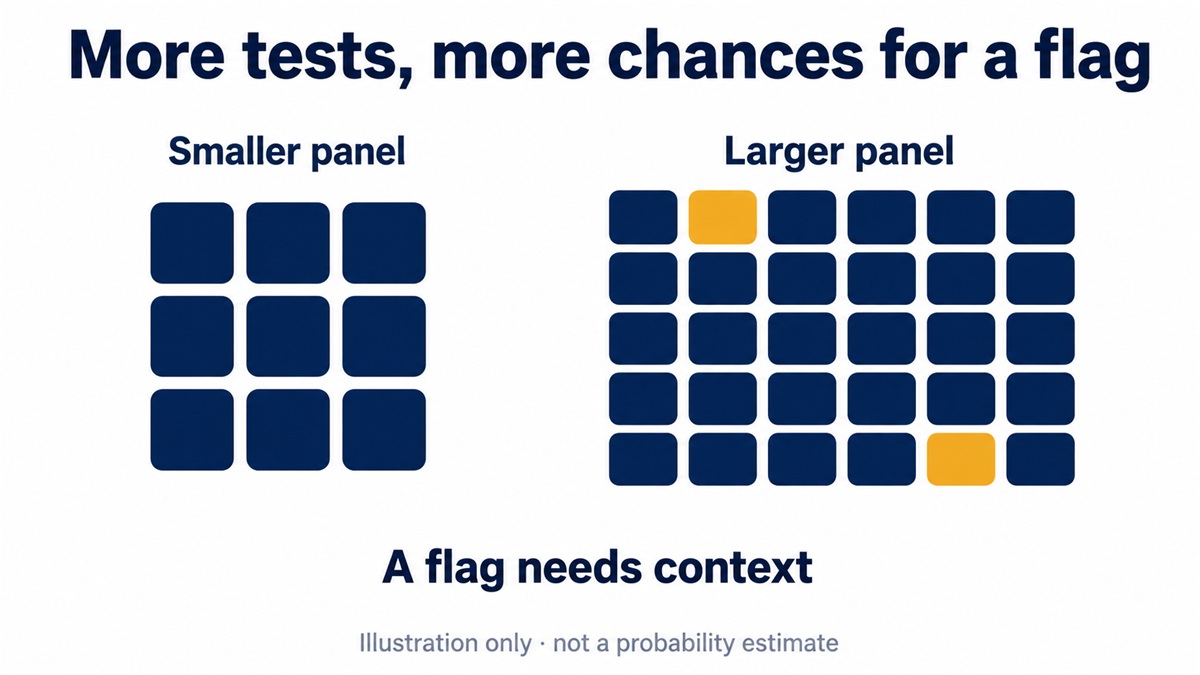
A reference range is constructed so that most of a healthy reference population falls inside it, conventionally the central 95 percent. That means one in twenty healthy people sits outside on any given marker, purely by design.
Run sixty markers and the expected number of out-of-range results in a completely healthy person is around three. Providers know this. Dashboards showing amber and red indicators generally do not explain it.
Why pretest probability matters
In clinical practice, a test is ordered because something in the history or examination raised the probability of a specific condition. That prior probability determines how much a positive result should update your belief. The same number carries very different weight in a symptomatic 70-year-old and an asymptomatic 30-year-old.
Consumer panels are ordered without any prior. Every result therefore arrives with the weakest possible interpretive context, in the format most likely to suggest certainty.
Order sixty independent tests on a completely healthy person and you should expect around three to come back outside the reference range. That is the arithmetic, not a finding.
Toracix Health Report
The follow-up problem
The cost of an incidental abnormal result is rarely the retest. It is the imaging that follows the retest, the specialist referral that follows the imaging, and occasionally a procedure with genuine risk, all triggered by a finding that was never going to cause harm.
This is a well-documented pattern in screening research. It is not an argument against testing. It is an argument for testing with a question in mind.
Using a panel well
Decide in advance what you are looking for and what you will do about each plausible answer. Take the results to a clinician who can situate them in your history rather than to a forum. Focus on trends across repeated measurements rather than single values.
And treat a marginal abnormality on a screening panel as what it usually is: a reason to repeat the measurement before doing anything else.
Before you order
What am I trying to find out, and what would I do differently for each possible answer? If nothing changes, the panel is entertainment.
Some providers include clinician review. Many deliver an algorithmic dashboard. The difference matters more than the marker count.
Single values fluctuate. Decide in advance that a marginal result gets repeated before it gets acted on.
Common questions
Are these panels useless?
No. Used with a specific question and clinical support they can be genuinely useful, particularly for people with poor healthcare access.
What if something comes back red?
Repeat it before escalating. Most marginal abnormalities on screening panels regress toward normal on retest.
Sources
- Biological age test: five methods compared by accuracy and actionability — https://mitohealth.com/guide/biological-age-testing